ROGER PARTRIDGE: The corruption of privilege (and why it matters)
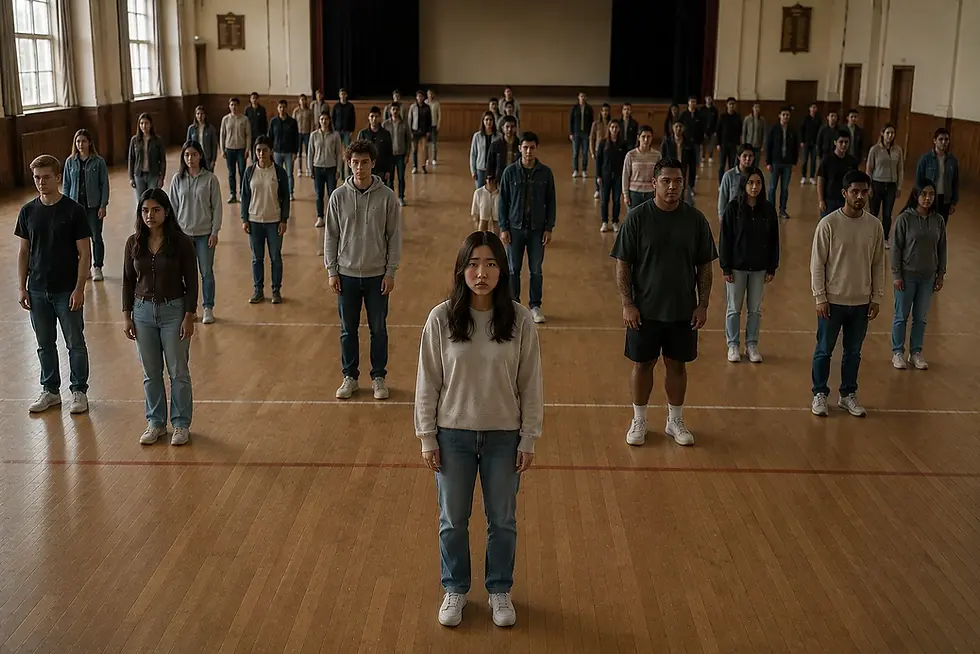
The exercise has many names – privilege walk, power line, power walk – and a well-documented lineage. It originated in North American social-justice education in the 1990s, drawing on Peggy McIntosh‘s 1988 working paper on the “invisible knapsack” of white privilege, and is run at school retreats, university orientations and workplace training sessions across the English-speaking world. The format is standard. A facilitator reads a list of statements, and participants step forward or back according to their answers. Step forward if you were raised by both your parents. Step forward if there were more than fifty books in your house. Step forward if your parents took you to galleries or plays. Step forward if you came from a supportive family environment.
By the end of the exercise, the lesson is plain. The goods of a stable home are privileges. The young person whose parents stayed together, kept books in the house, and sat down with her at the dinner table is the beneficiary of an unjust order. She has been carrying, without realising it, an invisible knapsack of unearned advantages.
This is a strange thing to call privilege. Over the centuries, the word has named two kinds of advantage – legal advantages conferred by the state, which liberalism set itself to abolish, and the material advantages of inherited wealth. To call a family dinner a privilege stretches the word past both. But the stretch does not shed the word’s moral weight. The dinner table now carries an accusation the word once reserved for guild charters and hereditary titles.
What privilege used to mean
For most of the history of English political thought, privilege had a precise legal meaning. The word comes from the Latin privi-legium: private law. A privilege was a legal advantage conferred by the state on particular individuals or groups, not available to others on the same terms. Hereditary titles, established churches, guild monopolies, racial caste systems, exclusive trading charters – these were privileges. They were what the long liberal project existed to dismantle.
Adam Smith used the word in this sense throughout The Wealth of Nations. His attack on the Statute of Artificers – the Elizabethan law that required seven years of apprenticeship before a man could practise a trade – is a sustained polemic against legal privilege. “The exclusive privilege of an incorporated trade,” he wrote, “necessarily restrains the competition, in the town where it is established, to those who are free of the trade.” A young man in a market town could not become a baker, a shoemaker or a tailor unless the corporation admitted him. The corporation, in turn, regulated who served and for how long, with the express intention of restricting numbers. The “exclusive privilege” was the law that made this possible. It was a tool by which the well-connected protected themselves from competition from the poor.
Smith was not alone. John Stuart Mill on the disabilities imposed on women, Friedrich Hayek on the rule of law as that body of general rules to which no privilege attaches, the long abolitionist campaign against the legal privileges of slaveholders, the suffrage reformers’ campaign against the privileges of property and sex – all of these turned on the same understanding. Privilege was a status conferred by law on some at the expense of others, and the work of liberalism was to abolish it. The achievements of that work – equality before the law, open entry to the professions, the dismantling of slavery and racial caste, the opening of universities, parliaments and courts to women – are easily forgotten because they have become the air we breathe.
Alongside this strict legal sense, a looser social usage developed in the nineteenth and twentieth centuries. To speak of “a privileged upbringing” or “the privileged classes” was to identify a background of inherited wealth and elite schooling – advantages that were unchosen and, many felt, disproportionate. The usage borrowed some of the moral weight of the legal sense. But it retained one feature of the original: the advantages it pointed at were, at least in principle, addressable. Elite schools could be opened up. Universities could admit on merit rather than birth. The response the usage invited was extension – more people should have access to those goods – not apology from those who already did.
The redefinition
The Wellesley working paper that gave the modern usage its vocabulary was written, in 1988, by an associate director of the College’s Center for Research on Women named Peggy McIntosh. The following year, an excerpt appeared in Peace and Freedom Magazine under the title that would carry it across the world: “White Privilege: Unpacking the Invisible Knapsack”. McIntosh listed dozens of everyday experiences she had not previously thought of as advantages. She could find a plaster the colour of her skin. She could be reasonably sure of being treated courteously in a shop. She could expect her children to be taught material reflecting their heritage. She called this an “invisible knapsack” of unearned assets. The word she chose – privilege – carried two centuries of moral weight, drawn most sharply from the legal sense Smith had used to attack the guilds.
McIntosh was pointing at something real. People do move through society with unequal frictions, and some of those frictions reflect genuine injustice that liberal societies should keep working to remove. Her paper was also more careful than its legacy. The list was about race, drawn from her own life, and she asked readers not to generalise beyond it. She thought privilege too soft a word for what she was describing, preferring to call it dominance conferred on one group at the expense of another. She distinguished advantages that ought to be spread to everyone from dominance that ought to be given up, and observed that some things read as privileges only because too few people have what should be the norm. Her notes for facilitators warn against step-forward exercises that position people in a single aspect of their identity. The work, she insisted, was not about guilt.
What travelled was not the paper but the word. The walk scripts – some of which describe themselves as adaptations of her paper – generalised it from race to the whole texture of family life, dropped the autobiographical framing, dropped the distinction between spreading and rescinding, and kept the moral charge.
When Smith called the guild’s monopoly an “exclusive privilege”, he was naming a transfer: a benefit conferred on the incorporated trade at the direct expense of the young man kept out of it. The word identified an injustice and pointed at a target – the statute, the corporation, the charter – that could be dismantled. Even the looser class sense kept a residue of that transfer story. So, in its own way, did McIntosh’s paper.
But when a privilege walk calls a stable home a privilege, the transfer story is gone entirely. The young woman whose parents stayed together has taken nothing from the young man whose did not; no statute, no corporation, no charter stands between them. Where the older usages invited extension – and McIntosh herself proposed spreading the positive advantages – the exercise invites guilt, with no target to dismantle. The founding author warned against exactly this use of her word. The warning did not survive the journey into the school hall.
What happened in the same forty years
The household evoked by the privilege walk – two parents, present, attentive – has become measurably less common over the very decades in which “privilege” was being reassigned. And its decline has been concentrated among the least well off – the people the framework claims to defend.
The causes of that decline are many. Deindustrialisation, the collapse of religious affiliation, changing sexual norms, assortative mating between graduates, and the long retreat of marriage as a cultural default all contribute. Anyone who claims a single explanation is either selling something or has not looked at the data. One further candidate is the design of the post-war welfare state. That question has a history: raised from inside the system in 1965, denounced, revived in the 1980s, and answered in part in America by the welfare reform of 1996. Since then it has gone quiet. The language of privilege helps keep it quiet.
In 1960, around eighty-eight per cent of American children lived with two parents. In England and Wales in 1961, the figure was above ninety per cent. New Zealand showed a similar pattern, with sole-parent households a small minority of the total. Stable two-parent family formation in those years was not the preserve of the comfortable; it was the ordinary condition of life on an ordinary wage. The factory worker, the bus driver, the shop assistant lived in the kind of household the privilege walk now identifies as privileged.
The mid-century social order had its own injustices, which the long liberal project has spent decades dismantling. But the family-formation pattern is a separable feature. What was once nearly universal across socio-economic lines is now concentrated at the top. To label as an inherited advantage what was, within living memory, the norm across the social spectrum, is to mistake a recent collapse for an entrenched inequity. The advantages McIntosh identified were not always advantages. They are advantages now because so many families have lost them.
In 1965, an Assistant Secretary of Labor in the Johnson administration named Daniel Patrick Moynihan published a Department of Labor report titled The Negro Family: The Case for National Action. Writing from inside the Democratic administration that was then expanding the American welfare state, Moynihan warned that some of the policies being built risked altering the incentives surrounding family formation among the urban poor. He was denounced as a racist, accused of “blaming the victim”, and largely driven from the field.
The figures that have accumulated since make harder reading than the denunciations. Thomas Sowell, the African-American economist, has pointed out that in 1960, twenty-two per cent of black children in the United States were raised with only one parent; by 1985, the figure was sixty-seven per cent. Charles Murray‘s Losing Ground (1984) offered a mechanism: the architecture of the post-1965 welfare system altered the relative payoffs of work and dependency, marriage and abandonment, with effects accumulating across a generation.
New Zealand has its own version. Norman Kirk’s Labour government introduced the Domestic Purposes Benefit in 1973 on humane premises. But the trajectory matters. The proportion of working-age adults on a main benefit rose from low single digits around 1970 to around one in ten by 2017, as documented in Bryce Wilkinson‘s Welfare, Work and Wellbeing. Nearly three-quarters of those on a benefit by age 25 had a parent on a benefit. The 2011 Welfare Working Group chaired by Dame Paula Rebstock found that almost one in five New Zealand children was living in a benefit-dependent household.
Whether Murray’s mechanism is the right one remains contested. The question Moynihan raised – whether benefit structures designed to relieve hardship could also, at the margin, entrench it – does not depend on Murray’s answer. The language of privilege makes the question harder even to hear. A framework that classifies the intact family as an unearned advantage cannot see its disappearance as a loss. Fewer privileged children looks, through that lens, like progress.
None of this is an argument against a welfare safety net. The welfare structures built across the twentieth century – on foundations laid earlier by families, friendly societies, churches and charities – reduced extreme material hardship. The argument is narrower. Benefit structures designed to relieve hardship can, if their incentive effects are not carefully thought through, also shift household formation decisions at the margin and, over a generation, contribute to family breakdown concentrated among the least well off.
Recovering the word
The young woman at the front of the privilege walk has not won a lottery, and she has not done anything wrong. Her parents stayed together; they read to her; they ate together. These are advantages. But they are not privileges in any sense that should produce shame. They are what most parents in most cultures, at most times, have wanted for their children, and they are increasingly hard to achieve among the families that need them most.
Calling her privileged for what her parents preserved mistakes the diagnosis. It tells the wrong story, and it tells it to the people least equipped to push back: the young, who trust their teachers and want to do the right thing.
The word “privilege” was, until recently, one of liberalism’s sharpest tools. While the privilege walk has been asking young people to feel guilty about their families, privilege in the original sense has carried on. Planning rules and consent regimes protect existing homeowners against new building at the expense of younger people seeking to buy, with effects measurable in some of the developed world’s highest housing-cost-to-income ratios. Regulatory thickets do the same work in banking and other industries. And in professions – especially medicine – specialist colleges ration entry to their own fields. These are privileges in the sharper sense – legal advantages conferred on some at the expense of others – and they are doing now what the guild monopolies did in Smith’s day. Smith called the spirit behind such arrangements “the vile maxim of the masters of mankind: all for ourselves, and nothing for other people.” The spirit is not always required now. Once made, the rules protect incumbents whether they ask or not.
Of the causes of family decline named earlier, which are reversible, and at what cost? What would it take, in 2026, to make the kind of life the privilege walk now stigmatises available again to low-income families in New Zealand, Britain and America? Benefit rules that penalise a second earner in the house, or a parent for living with a partner, can be redrawn. Other causes lie deeper, in cultural and economic shifts that no government can simply legislate against.
But it is the question a serious account of family decline has to start with – and the language of privilege stands in its way. To call the intact family a privilege is to treat its scarcity as part of the natural order. It is not. Within living memory, it was simply how most families lived. The challenge for liberalism is to make it ordinary again.
Returning the word “privilege” to its older use would do more than restore a definition. It would restore our capacity to see the actual injustice in the room: not that one young woman stands at the front, but that so many of her classmates now stand at the back.
Roger Partridge is Chairman and Senior Fellow at the New Zealand Initiative. This essay is part of an ongoing series on liberalism, democracy, and the international order. Related writing in Persuasion, Quadrant, Quillette and on Plain Thinking is collected here.
I think it's similar values that draw people together not so much privilege.
Another excellent and thought provoking article, Roger. Thank you. John R.
An excellent article, thank you.
I wonder what would happen if the opposite happened and all those who stepped/stayed back were labelled "neglected" thus making their target for blame clear, instead of just being envious of those brought up in a loving, two-parent home who want their children to be well educated.
Children who are loved are not privileged. Sadly, here in NZ, they are fortunate.
How about swapping privilege for responsibility, something lacking in the maori culture/religion. Go look for it in the maori dictionary.