ANI O'BRIEN: Politicising a Tragedy: PSA takes the gloves off
- Administrator

- 8 hours ago
- 13 min read
New Zealand's largest public sector union increasingly sounds like an opposition party.
The death of a man in the waiting room toilets at Waikato Hospital’s emergency department is a tragedy. He went to hospital needing help and died before he could be treated. His family, and the community, deserve to know what happened, whether it was preventable, and what needs to change so it does not happen again. That is the serious version of this conversation. But unfortunately, we are in an election year and serious conversations are not what some of New Zealand’s unions appear to be interested in when a tragedy can be turned into a political opportunity.
The rhetoric quickly travelled well beyond scrutiny and into political prosecution where they stopped just short of calling for the Health Minister to be charged with murder.
“No-one should be waiting nine hours or even longer at any Emergency Department,” began the Public Service Association’s press release. While that is a reasonable wish, it is one New Zealanders have been wishing for quite some time. Successive governments have regarded completing 95% of ED visits within six hours as the benchmark. Under the previous Labour Government, performance on this metric steadily deteriorated. Around 90% of patients were completing their ED stay within six hours in 2016 under National, but by 2022–23 that had fallen to around 70–72%, meaning the proportion of patients waiting longer than six hours had roughly tripled from around one in ten to almost one in three. Since the current Government took office, that trend has begun to reverse. While performance remains well below the 95% target, the proportion of patients completing their ED stay within six hours has gradually improved to around 74%, meaning fewer patients are experiencing extended waits than at the end of Labour's term.

The Public Service Association is New Zealand's largest trade union, representing around 95,000 public and community sector workers in negotiating employment conditions. They claim to do this while remaining formally independent of any political party. By the end of this piece I think even honest Labour supporters will agree that is nonsense.
The PSA’s response to the tragic death was written as though there could only be one possible explanation for what had happened and that was that this Government’s decisions were directly responsible. Condolences to the family were followed quickly by a pointed hope that Minister Simeon Brown is “thinking very carefully himself about how his Government can look to stop tragedies like these happening in future.” Their press release was an explicitly political statement. The Government’s funding decisions and various other failings, the PSA argued, were putting lives at risk.
As part of a normal political contest, this is unremarkable. Opposition parties do this all the time. Labour’s Chris Hipkins was hardly subtle either, saying doctors and nurses had been warning that this sort of tragedy could occur because of staffing shortages and that the Government had been denying the crisis in emergency departments. That is politics. Cynical politics, but politics nonetheless.
But this week’s PSA press release was just the latest in a long line accusing ministers of choosing “cuts” over patients and warning that people would literally die because of government policy. However, this time they took things a step further and explicitly called for people to vote for Labour and positioned a change of government as the solution to our health woes. This death in Waikato ED was their proof of ministerial and government negligence.
However, just like with the waitlist narrative, the PSA is playing very fast and loose with truth in the characterisation of funding, staffing, and the state of the health system. National Secretary Fleur Fitzsimmons claims that the death in Waikato Hospital ED was “a damning snapshot of what Aotearoa’s health system looks like under this government - chronically under-funded, under-staffed, and completely overloaded.”
Let’s start with funding. Under successive governments New Zealand health funding has consistently and significantly increased no matter who is in charge. Total Crown health expenditure went from NZ$15.160 billion in FY2016 to NZ$30.6 billion budgeted for 2026/27 almost doubling nominally. Unsurprisingly, a big surge did come under Labour throughout the COVID period. Spending went from $20.5b in FY2020, to $22.6b in FY2021, and $27.7b in FY2022. Then the current Government, like the last, has increased spending each year meaning spending on health has never been as high as it is today.
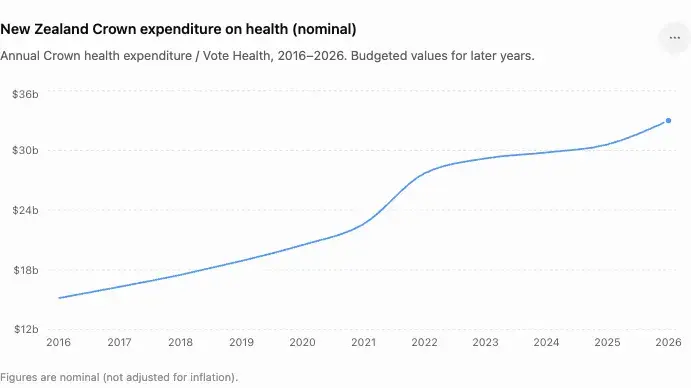
Now, these ever-growing numbers sadly do not mean the system is flush with cash or that every dollar has been spent well. It does not change that the system always needs more and that our demographic pressures are increasing. But, it does mean the cynical slogan that the health system has been starved by the current Government is inaccurate.
Nonetheless, the PSA joined forces with the Association of Salaried Medical Specialists and the NZNO to release a report they ominously called ‘Budget 2026: A Managed Decline for Health’. In it they claim the recent Budget left the health system between $300 million and $600 million short of what was needed simply to maintain existing services.
But the unions’ own analysis contradicts their claims of “cuts” and austerity. They acknowledge that the Government set aside $1.37 billion in Budget 2024 specifically for health cost pressures in each of the following two Budgets. They say the problem with that is some of it was used for new initiatives and to replace expiring programmes instead of being devoted entirely to inflation, wage settlements, and demographic pressures. They advance the same argument regarding the $1.45 billion increase for health in Budget 2026. And this is a perfectly legitimate criticism of budgeting priorities, but it is different from claiming the Government has simply “cut” health funding or abandoned the sector.
As I say, the unions are absolutely entitled to disagree with the Government. However, the contrast with the PSA’s public commentary during Labour’s final years in office paints an interesting picture. Between 2017 and 2023, emergency department performance deteriorated dramatically, specialist waiting lists grew, and workforce shortages intensified despite health spending increasing by billions of dollars. Yet the PSA’s public messaging during that period was generally one of welcoming increased investment and describing successive health budgets as moving “in the right direction”. Today, by contrast, virtually every Government announcement on health is met with claims of “slash and burn”, “managed decline”, or “wilful destruction”.
None of this proves the unions are necessarily wrong about every funding concern they raise. Health systems are expensive, demand continues to grow, and people can disagree about whether Budget 2026 allocated enough to meet future pressures. But when the same organisation responds so differently to similar systemic problems depending on which party occupies the Beehive, it is fair to ask whether its interventions are driven solely by the interests of its members, or whether they are part of a broader political campaign.
It is also worth remembering that an extraordinary amount of the funding allocated to health under Labour went towards their restructure of the health system. The workforce pressures we see today existed back then, elective waitlists were blowing out, ambulances were having to queue outside ED, and as already traversed, ED wait times were longer. On top of this, we were in the midst of a pandemic. And yet, Labour decided to undertake the largest restructure in decades axing DHBs and creating two separate health systems, Health NZ and the now-disestablished Māori Health Authority.

Likewise staffing shortages have not disappeared under the current Government, but it is not true that they are a product of it. The health system inherited longstanding workforce shortages that developed over many years. Since late 2023 when the Coalition took over, the frontline nursing workforce has actually grown significantly and nursing vacancy rates have fallen, although demand continues to outstrip supply in many parts of the system. Health NZ's workforce data shows practising nurses increased by more than 9,000 between March 2023 and March 2024 and estimated nursing vacancy rates within Health NZ fell from 10.8% in 2023 to 6.8% in 2024, largely due to increased international recruitment.
Staffing will continue to be a headache for whoever is in charge as Health NZ projects that, under current models of care and future demand, New Zealand will require thousands more health professionals over the coming decade. Nonetheless, the evidence points currently to gradual improvement from a difficult starting point rather than a worsening situation.

Yet the union rhetoric of the worse period pre-2023 was far more forgiving, focused on a collaborative approach to bargaining and workplace issues, and much less eager to frame every failure as evidence of a cruel and ideologically deranged government. One can chart the PSA’s partisanship through the glaringly different language and tone, and the amount of grace it is willing to give the government in its press releases. Of course, there wasn’t zero criticism under Labour. In 2018 the PSA said DHB administration workers’ neglect had reached a chronic level and warned that understaffing could put patient safety at risk. I point this out because the argument is not that the PSA was silent under Labour, but that the framing was different. It was operationally focused and provided context. Under the current Government, the PSA rhetoric is accusatory, angrier, and much more obviously political.
In the most recent Labour-era, the PSA’s headlines did not usually explicitly name Labour or frame health problems as a government-wide political failure, and were even openly favourable to Labour Budgets. Under the current Government, the PSA has said health is “in crisis” and Government policies are to blame. They have accused Ministers of putting “saving dollars ahead of saving lives”. Releases warned that “cuts will cost lives”, that “patients will die”, and “lives will be lost unless these cuts are stopped”. All of this despite the fact that the Government has increased health spending beyond what Labour spent, elective waitlists are shorter, and ED visit wait times are improving.

The New Zealand Herald’s Audrey Young pointed out the PSA’s political partisanship in a recent column. She reminded readers that when Labour announced a drive to find around $4 billion in savings in 2023, the PSA’s response was measured and supportive. It said that while there is never a good time to cut spending on public services, it understood that as revenue falls during challenging economic times, savings need to be found. When Nicola Willis announced savings measures a couple of years later, she may as well have dropped a bomb in the PSA offices. Public services would be “decimated”, National Secretary Fleur Fitzsimmons said. And the plan was “reckless”. Young’s conclusion was that perhaps the PSA should stop pretending and simply affiliate to the Labour Party. Judging by their Waikato ED press release, they have well and truly set off down that path.
The PSA’s defenders will say the Coalition is simply more hostile to unions and public servants than Labour is. Sure. Historically, a centre-right government pursuing fiscal restraint will encounter more conflict with public sector unions than a Labour government instinctively close to organised labour. And nobody expects the PSA to respond identically to different policy programmes, nor that they won’t critcise the Coalition. The issue is whether the PSA’s criticism is proportionate, consistent, and honest about its political character.
The awkward fact for the unions is that Labour had six years and did not fix any of the problems they now rage at the Coalition for. Labour massively increased health spending and restructured the system, and still left office with overcrowded hospitals, exhausted staff, ED delays, waiting lists, and chronic workforce shortages. And if the crisis is not new, which it isn’t, it cannot honestly be presented as a result of this Government being uniquely cruel. If the Coalition is continuing to fund Vote Health at all time high levels, which it has, then the argument cannot simply be that this Government has “cut” health. If the problem is that demand, inflation, workforce shortages, and system design are still overwhelming even very large budgets, then they should say that. But that is a much softer and less useful message for unions that appear very invested in helping Labour prosecute a campaign of National cuts, people die.

It is not a personal attack to mention the political contexts of leadership when a union is behaving overtly politically. In this case, the personnel involved is materially important. Fleur Fitzsimons is the PSA National Secretary. She has a long history with the union, was previously a Labour Wellington City Councillor, but most relevantly she was also the Labour Party’s 2023 candidate for Rongotai, finishing second to Julie Anne Genter, and failing to enter Parliament on the List.
She has been a visible Labour figure in Wellington for many years, is a friend of Chris Hipkins and other senior Labour MPs, and has been outspoken in the media on issues that the Coalition plainly are at odds with her on.
In the aforementioned Waikato ED press release, Fitzsimmons said:
"The state of our public healthcare system is unacceptable and is the result of the choices the Government made to give tax breaks to landlords and big tobacco rather than properly fund the health services New Zealanders need.”
These are Labour Party lines that have been repeated ad nauseam throughout this term of Government. They are political lines that stretch the truth and are designed to force the Coalition to explain how interest deductibility works and that they actually put up tobacco excise tax. As the saying goes: explaining is losing. In any case, Fitzsimmons has completely dropped any pretence that she is not acting with the objective of getting Labour back into Government. She ends her comments with:
"Our message to New Zealanders come the election is simple, vote to change the Government for one that properly funds health."

The PSA is obviously political and no matter how much they deny it, they are essentially an arm of the Labour Party. The key issue with pursuing the aggressive political objective of changing the government while purporting to represent 95,000 workers, is that this pretends their members have no political diversity. Too be fair, it is quite evident that Wellington is skewed heavily to the Left and the PSA likely does have a disproportionately Labour-supporting base, but PSA members are not all Labour voters. Nurses are not all Labour voters. Some may have voted National, Act, or NZ First because they wanted fiscal restraint, tougher law and order, were sick of identity politics, or liked that bald Air NZ guy. Some may have voted Green or Te Pāti Māori. And some will have voted for one of the ‘freedom’ parties that cropped up at the last election in reaction to COVID. That is democracy. But when a union funded by members across the political spectrum uses its institutional voice to promote one side’s political narrative, members who disagree are effectively forced to subsidise campaigning against the government they voted for.
Nobody sensible denies that Waikato ED was under intense pressure this week. Witnesses described a packed waiting room, stressed nurses, and chaotic scenes as staff tried to revive a man who had been found unconscious. Health NZ confirmed the patient had been triaged and later found unconscious, and Health Minister Simeon Brown described the situation as terrible and “clearly” not good enough. He announced there is to be a rapid clinical review and a serious adverse event review. It is a terrible tragedy and there must be accountability, but the jump from “this is a terrible failure requiring investigation” to “this Government’s cuts killed him” is a political leap, not an established fact. It may be emotionally satisfying for those already opposed to the Government to accept the framing, but it is dishonest framing.
None of what is playing out in the media and in press releases this week is really about a poor man who died in an ED toilet. This incident is being used as a vehicle to plant messages in fertile soil. Labour and the unions know the public cares deeply about hospitals and health is one area where New Zealanders always want more funding. There is a reason why the portfolio of health is seen as a career land mine. Prime Ministers need one of their best ministers to manage the mammoth role, but there is no winning as health minister. There will always be more need than can be met immediately and accountability for that inevitably lands at the minister’s feet.
Labour and their union proxies know that every long wait, tragic death, crowded ED, and exhausted nurse can be turned into a story about Coalition cruelty if the surrounding context is carefully omitted.
I am not, to be very clear, saying the Coalition is blameless. There is plenty to criticise them on and productive conversations about spending priorities would be fruitful in my view. What I am talking about, as per usual, is narratives and framing. The union narrative is incomplete and sometimes incomplete is worse than false because it uses fragments of truth to build a misleading picture. It is true that Waikato ED was under huge pressure, that there are staff shortages, and patients are waiting too long. It is also true that the hospital, Health NZ, and the Government should be held accountable for their decisions and how they may have contributed to this tragedy. But the implication that this is all the product of Coalition cuts, rather than the latest manifestation of a health system that has been struggling despite years of record spending, reform failure, and workforce shortages, is political spin. Worse, it is political spin delivered by organisations that still expect to be treated as neutral representatives of workers rather than active participants in Labour’s campaign strategy.
The PSA are entitled to pick a side and they already have. They just need to stop pretending they haven’t. If they believe their members’ interests are best served by Labour, they should say so openly. But they must do New Zealanders the respect of honestly explaining why. It cannot be because the Coalition is spending less, because they aren’t. Nor can it be because ED wait times have blown out, because they are decreasing. Nor that the elective treatments waitlist is worse, because the opposite is true. And the unions should be well aware that the workforce is growing because they are no doubt collecting the extra dues. I would love to know what their reasoning is once they have taken all of this into account.
Trade unions play an important role in New Zealand. I come from working class West Coast stock and Grandad worked at the freezing works in South Auckland for most of his life. I am very conscious of the high regard he held unions and the Labour Party. I daresay he would not recognise either were he still alive. Through him I learned the immense contribution unions have made to our country’s history and to all of our rights as workers.
When I criticise the unions today, it's because they no longer seem to exist to represent workers, negotiate better conditions, and advocate for the professions they serve. They have become petri dishes of every hard left cause from gender identity to Palestine. They are also now highly populated with tertiary educated policy wonk types who have never worked a waged job. Gone are the days of the union run by the actual workers. Theorists run the show.
It appears to me that rather than working for their members, their members have become the product. Unions are able to mobilise protestors, submissions, and votes quickly because they keep their database primed by drip feeding them reasons to hate this Government. I have no doubt that many in the health sector would be astonished to see the graphs and numbers in this piece. They are experiencing the pressure in the system, no matter that they have experienced it for years, and they are being repeatedly told that things are worse. Everything is worse and it is all that Simeon Brown’s fault!
The unions have taken very real problems in our health system and packed them with partisan political conclusions. At every opportunity they have conveyed this narrative to their members, reinforcing with each email or social post that this Government is uniquely terrible and evil. It doesn’t matter that the numbers do not back up their claims, because if you can win the narrative and control the framing, you can set perceptions.
Ani O'Brien writes at Thought Crimes
The obvious question i would ask is how many people choose to use ED as a free GP visit, its called emergency for a good reason.
When might media research this?
How can anyone call a bureacratic bungle that spends so m8cb of other peo[es money to increase the numbers of ill citizens a HEATH SYSTEM? Things might get better if the people we call the government got out of the way.
Going off topic from Ani's point and looking at Healthcare. It is a political issue and one that incumbents government invariably fail.
Given aging populations in developed economies, healthcare is a major issue. You can never seem to spend enough. I just checked healthcare spending as a % of GDP ( both public and private). NZ sits right on the OECD average 9% ( 7% publicise funded, 2% private). Much of Scandinavia is also around 9%. Outliers are USA (17%) and Singapore (5%). UK spends around 11% , Australia 10%.
It becomes interesting when you compare outcomes - Life expectancy, infant mortality, treatment times. The NHS ( the dominant supplier ) in the UK has similar problems to N…
My concern I guess is that with all the politicised finger pointing, a real problem that something can be done about slips through the cracks, or is possibly fixed at this particular hospital but not elsewhere, then we get more deaths and lesser disasters. My own several experiences of NZ A&E is that there is room for much better monitoring of walk-ins who are waiting for long periods whilst sick or injured. As it is, after an initial triage that could easily be a misdiagnosis as they are usually not conducted by physicians, patients are required to just sit there and wait, often in pain or otherwise quite poorly. Nobody regularly checks to ensure each person is holding up ok, i…
Ani,
Thank you. You have made the situation clear, and the four graphs clearly show that.
I don't hold anything said by Hipkins or his lackeys the PSA, as being meaningful or truthful. They are brown shirts and loyal to the Labour Party hierarchy.
"The rhetoric quickly travelled well beyond scrutiny and into political prosecution where they stopped just short of calling for the Health Minister to be charged with murder."
If the unions are that motivated by one needless death, how would they respond do thousands of needless deaths? Would they be asking for those accountable to be convicted and serve 300 year sentences with no chance of parole? Or perhaps hold protests demanding the re-introduction of the death…