LINDSAY MITCHELL: The Anxiety Epidemic

Over the last twenty years the number of people depending on a benefit due to psychological or psychiatric reasons has increased by 140 percent. Meanwhile the working age population grew by just 26 percent.
In June 2006 the number dependent was 37,300. Fast forward to June 2026 and it's 89,385.
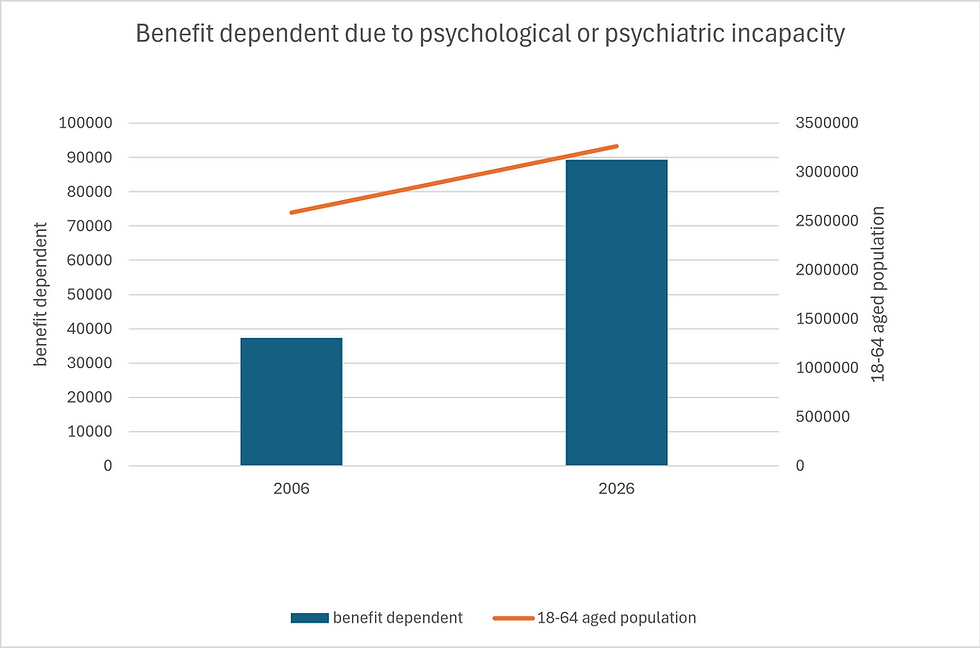
89,385 is a very big number. It does not include people with an intellectual disability, those we might traditionally regard in genuine lifelong need of community support.
Ironically, paying people to be inactive and isolated is probably the worst approach to improving their mental state.
Part of the reason for the disproportionate growth in numbers is that people are becoming reliant younger and staying reliant longer.
2024 data showed that under 25-year-olds who go on Jobseeker with a Health Condition or Disability (JS-HCD) will spend a further 23.3 years reliant - in 2023 the expectancy was 20.6 years. The year-to-year 13.1 percent increase in future years is larger than for any other benefit.
NZ isn't alone with this problem.
UK Conservative leader Kemi Badenoch said last year:
"We should be aiming for everybody to support themselves as far as they are able, while providing support for those who cannot.
But to do this, we will have to win arguments. Arguments that too many in politics have forgotten how to make. Like a life of work being better than one dependent on the state.
Not just better for society, although we believe that too, but better for the soul. That it feels better to contribute and enjoy the freedom that comes with paying your own way.
Too many young people are growing up not knowing that. They think that a life on benefits is an alternative to working. They think isolating themselves at home is okay because starting a job feels daunting."
As a parent of two in the generation she speaks about, I have seen mental distress. Luckily mine are amongst those who have pushed themselves to work and be independent. At times. the jobs haven't been what they want but they've reckoned any work is better than no work, recognising that a lack of purpose, listlessness and loneliness lead to anxiety and depression.
In November, National will be restricting access to the Jobseeker benefit (including JS-HDA) for 18-19 year-olds. (ACT is also campaigning on tightening up the medical certification process.)
This causes outrage from the left.
The Greens constantly oppose efforts to stop young people getting into the dependency trap. Green spokesman Ricardo Menendez-March says the policy is cruel:
“The National Party has a long history of dehumanising people who struggle to get by on a day to day basis."
I am diametrically opposed, believing both the Green's Income Guarantee or TOP's Citizen's Income from age 18 would seriously damage young people's motivation. If both parties are in government together the likelihood of a universal income being implemented increases.
If someone under twenty cannot find a job, they should be training for one. The late teens is a crucial time. The last thing they need is to be derailed with 'free' money to stay in bed.
Far too often, beneficaries who have been encouraged to go on benefits whether for physical, mental or emotional issues by the Welfare State being available & pushed by the medical est...!
So often, DEPRESSION, which has been described by Dr. Clement Stone a Professor of Psychology at Harvard University as "Suppressed ANGER"....makes one think of how many people are harbouring such deep ANGER & not really dealing with the underlying issues/causes, either by self correction or via professional help....unfortunately, far too often, professional 'help' leads too easily towards "suppressive toxic synthetic drugs" which tends to compound the particular individual persons suppressed ANGER with them ending up being a 'zombie' not capable of take care of their own like by being…
Everyone is capable of something, some work, some self esteem some sort of job satisfaction.
There is no shortage of jobs, even three months of seasonal work is better than nothing.
Any politician that promotes dependence on the state should be thrown out.
Where is the can do attitude - absolutely love visiting Asia where people have this can do attitude - quite lifting.
Picker an grin, dead right, I dont need to grow things but I do, its incredibly good for the soul, body, self esteem. However as you say its probably in the too hard basket, when Im driving I see houses with amazing areas for a vege garden, needs very little outlay, eg, spade, hoe, packet of seed and you can help feed your family (also feel good). I remember when Dame Phina Cooper was doing her trek through NZ she exclaimed, " where are the gardens my people", funnily enough there are plenty of cars and sky discs.
A good days work is like a medicine for the mind.......being paid to waste your life on the couch, dwelling on what might be, allows people time to believe they have a mental condition that is only exacerbated by their lack of productivity and the feeling of being useful.
Who is going to have the gonads to say it's another 'failed fix' that is helping to cripple this country....
Well, my job is secure. Nobody else wants it.