DR DAVID SMYLIE: I left New Zealand over an email
I left New Zealand over an email.
It was a private, four-sentence reply to a sales rep, sent late one night.
For that, the Medical Council found my comments “objectively racist” and put me through a year of ‘re-education’ that I was expected to pay for myself. In the process, New Zealand lost a GP with almost 40 years’ experience and a deep commitment to genuine patient care.
I’ve just told the whole story on the Free Speech Union’s Free to Speak podcast, which you can watch here:
Here’s how it started
I’ve practised medicine in Britain, Australia, the US and New Zealand, including two years providing care to Aboriginal Australians in the Outback. In 2022, I was a senior partner at Cambridge Medical Centre in the Waikato. I had a blemish-free record.
That November, a sales rep from a nutrition company emailed me and other health professionals an invitation to a sponsored education evening. Her email opened “Ate Marie Everyone”. She meant “ata mārie,” meaning “good morning.”
I’m a Scot with a dry sense of humour, and I couldn’t resist the typo. I replied the moment I read it:
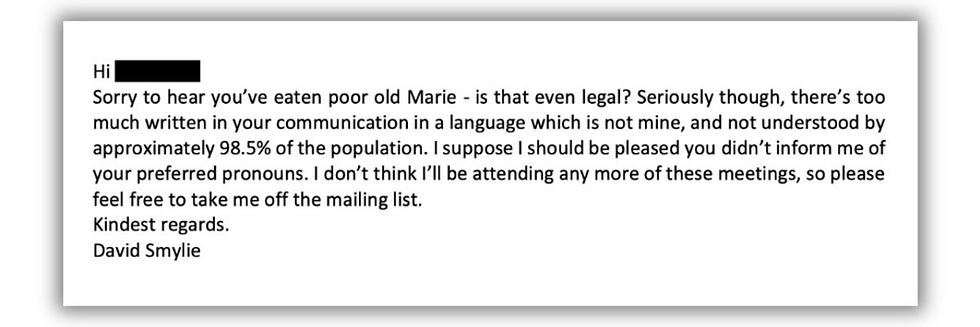
Was it wise? No, and I wish I hadn’t sent it. It was a hasty, knee-jerk reaction to the language in her email, not a calculated attack on her. It was also private: it went to her alone, and none of the other invitees were copied in. And she was a sales rep, not a patient or a colleague. I didn’t think it was a big deal, and it never crossed my mind that I might hear from the Medical Council over it.
Nine days later she wrote back saying it was “offensive and inappropriate”. That same day, her manager reported me to the Medical Council.
Then the Medical Council got involved
I did what I thought a sensible professional should do. I didn’t argue. I went along with the process. I regretted doing so later.
Within days I’d written to the Council with an apology for her, and in January my lawyers asked for it to be passed on.
In February 2023, before the Council had even referred my case for investigation, I did three online courses off my own bat, on bias in health care, disability equity and cultural competency. Five or six months later, the committee investigating me would demand I send them a written critique of what I’d learned.
In May the Council appointed a Professional Conduct Committee to investigate me. They interviewed the rep and her manager. The rep told the committee an apology would have made her feel a lot better. Mine was sitting in the Medical Council’s file, and nobody had told her.
When the committee’s chair suggested she might meet me face to face, one of the other members jumped in and warned her off. Meeting someone like me could be bad for her mental health: “…a bit hard, isn’t it? Traumatising?” And in the same breath: “it’s tough calling out racism.”
I could have appeared before the committee in person. But having read those transcripts, I didn’t believe I’d get a fair hearing. In August my lawyers asked again for my apology to be passed on. Still nothing.
So why was my apology never passed on? First, because she hadn’t been the one who had complained, the Council had “no basis” to pass it on. Then the Committee made her a formal complainant anyway, but decided that passing on my apology would “interfere with an active investigation”. Their own investigation. Finally, they ruled that an apology only has value if it’s made directly, at the time, and therefore refused to pass mine on at all. You really couldn’t make it up.
The verdict
In September 2023, the Committee delivered its verdict. My comments were “objectively racist, offensive, and insensitive”. Whether I’d meant any harm was “of little consequence”. My four sentences even had “the potential to contribute to current health inequities”. The three courses I’d done unprompted were only “the beginning of your journey”, and I lacked “insight”.

It acknowledged that my practice had “not yet received a complaint” about my care. Note the “yet”. Even so, it couldn’t rule out that I’d be a risk in future, especially to the Māori community and to patients “whose gender expression is important”. That last part came from my remark about pronouns.
The committee’s remedy was “counselling”. In practice, that meant what I’d call twelve months of reprogramming. The Council called it an “Educational Programme”. I had to see a Council-approved supervisor every month, and the supervisor reported on me to the Council every month.
There were readings on Te Tiriti, colonisation and institutional racism, discussion of “the concept of diversity, equity, and inclusion (DEI) as a concept”, and strategies for managing my “implicit biases (which are inevitable)”. If the supervisor reported badly on me, my case would go back to the Council.
At the end I was to write two essays: 500 words reflecting on my email, and 1,000 on structural racism in New Zealand health care. And I was expected to pay for all of it: $125 an hour plus GST for the supervisor, plus their travel time and petrol.

As it turned out, I didn’t pay the supervisor a cent. The Council eventually agreed that one of my partners at the practice, who had a lot of experience teaching students and trainees, could take on the role, and she kindly didn’t charge me. (I made sure a few bottles of very good wine and some flowers came her way at the end.)
But that doesn’t change the principle: the Council expected me to pay for my own punishment.
Before the programme started, I’d managed to apologise to the sales rep directly, and she had accepted. My lawyers told the Council, and asked for the programme to be halved and the essays dropped. It went ahead anyway. I sat through all twelve sessions.
But, out of principle, I would not write those essays.
So I left New Zealand
So, I left. I’m now practising overseas. I’m told I might be allowed to work in New Zealand again if I write them. Clearly, that is not going to happen.
Those two years were a living nightmare. I lost more than 10kg and a great many nights’ sleep, over something a sensible regulator would have settled with a quiet word.
At a time when Health NZ are reporting severe staffing shortages, and are looking to bring in staff from overseas, I have to be blunt: based on my experience, I would not advise any health professional to work in New Zealand until the regulators get back to their core purposes.
The Free Speech Union is asking for regulators to stay neutral and stick to their core purpose and function of keeping patients safe, and I hope that spares the next doctor or nurse in my position.
I loved living and working in New Zealand, and it really saddened me to have to leave in the circumstances that I did.
Best wishes,
Dr David Smylie
Former senior partner | Cambridge Medical Centre

This article was sourced from a Free Speech Union email and included the following addendum:
NB. When the Free Speech Union heard Dr Smylie’s story, we thought our supporters should hear it too, so we asked him to share it with you, and he kindly agreed. Dr Smylie isn’t formally affiliated with the Union, and we’re grateful to him for speaking up.
Shades of Janet Dickson, who lost her real estate licence for refusing to attend a compulsory maori indoctrination programme that had nothing to do with selling real estate
This is nothing but communist commisarism!These regulayors need to get rid of the cultural commisars! FFS!
we have no room for dry scotch. i take mine with water... my lot came here in 1840. helped save maori from extinction actually, but clearly something lacking in my skin pigmentation- & if i had been put through what you were, i'd emmigrate to b... near anywhere.
look around the world- with alliances breaking down- the middle east collapsing into strife over land possibly occupied 2000 yrs ago- west going down tubes- not to mention diesel...
newsflash- if we cant turn maori into reasonable people damn soon- look what awaits us. a country that didnt have a care in the world
every govt has pledged to end waitangi. AND? AND?
Welcome to our Brave New World.
Wish dr smylie had named everyone on the council or committee who passed judgment on him.