ANI O'BRIEN: What will Hipkins have to give away to become Prime Minister?

Kiwipower, KiwiMart, Wealth Taxes, and Te Tiriti: What survives negotiations?
Every election campaign we, the voters, are treated to a pantomime in which parties make promise after promise about what they would do if given the power to rule these small isles. Most of us have been around long enough to recognise that a great deal of these plans are poorly thought out fiction but we will attempt to discern the realistic from the outlandish. The others will vote Green until they become a parent, own property, or simply fully develop their frontal lobe.
Ooosh. That was a bit mean. I nearly deleted it but then I remembered that even with access to an internet that contains scores of images and knowledge of what communism does to populations, the self-important fools are still pitching it as the answer to our problems. I usually try to deal in the policy and enjoy exploring the various ideas proffered by parties, but I simply cannot stomach the sheer stupidity and recklessness of people promoting the most deadly ideology in our history… in 2026.
Anyway, under MMP, shortly after the votes are counted, we will be able to see whether the left bloc or right bloc have the majority and are able to negotiate forming a government. And oddly enough, the promises made to us in the months preceding will suddenly matter a hell of a lot less.
The government we get is one nobody voted for explicitly. It is assembled afterwards, behind closed doors, by several parties horse-trading over the very policies they spent the previous 6 months insisting were “bottom lines”. Some promises do survive intact, others get watered down, and some disappear faster than the campaign hoardings the night before Election Day. Policies will be scrapped over and roles demanded. I like to imagine cabinet is put together like Simon Cowell on X-Factor with photos of the contestants on a table being switched in and out.
Power dynamics ebb and flow because it is in these negotiations that the smaller coalition parties hold the most power that they will hold for the next term. Without their agreement we will all be plunged into another election and so they have the leverage to make audacious demands. Sometimes that results in two people taking turns as Deputy Prime Minister.
This election’s dynamics feel more chaotic than usual and even more existential. Though I suspect we may all say the same thing when we endure the process again in 2029. While the right bloc of National, ACT, and New Zealand First comes with its own intriguing circumstances, we have seen them campaign, negotiate, and govern together before. We have an element of familiarity with the particular kind of dysfunction they are susceptible to. Much more interesting is the prospective left bloc of Labour, Greens, Te Pāti Māori, and potentially Opportunity. And not just because the possibility is one I regard with particular horror.
If Chris Hipkins is to become Prime Minister after 7 November, he will need to form a coalition with a group of parties campaigning on some of the most overtly transformative policies we have ever seen. I acknowledge that for some that transformative potential is desirable and for others it will prompt a visit to various countries’ immigration websites.
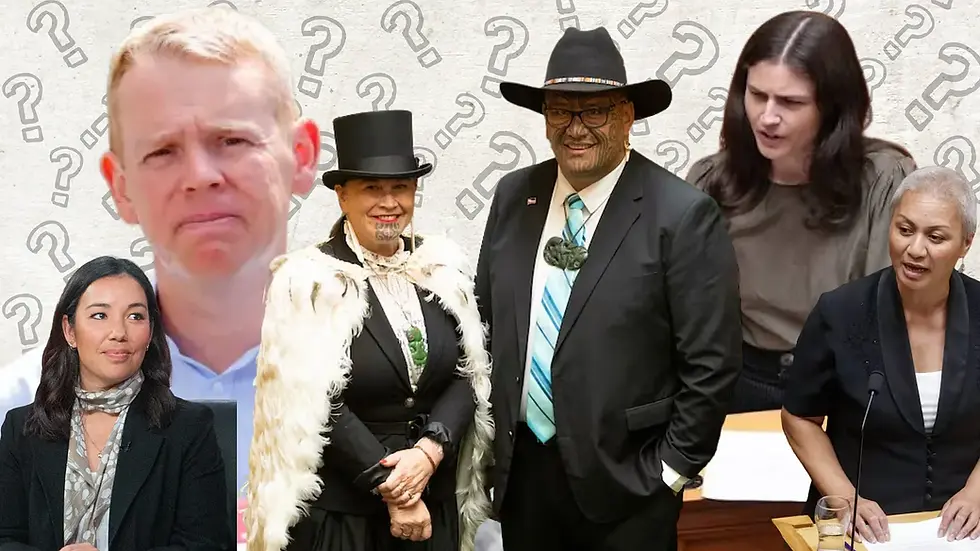
Labour has thus far campaigned (once they actually climbed out from behind the rock they were hiding behind) on moderate centre-left policies. They have not introduced much policy at all preferring to hope that the existing Government will simply lose the election all on their own. However, in leaving a void, Labour have allowed plenty of room for their allies to drop policies so wild that Hipkins has had to sprint to rule them out. In fact, Hipkins has probably spent more time ruling out the policies of other parties than speaking about his own.
Greens, Te Pāti Māori, and Opportunity fundamentally disagree with Labour on taxation, constitutional arrangements, welfare, public ownership, and a whole lot more. In many ways, Labour has more in common with National than the parties to their left. This causes significant concern for those who imagine the possibility of a grand blue and red coalition. However, there is some extensive overlap between Labour and the far left, particularly on climate policy, workplace law, government intervention in markets, and the role of the Treaty of Waitangi. It sometimes seems that Labour MPs envy how far their left bloc colleagues can take policy, resenting the fact that in a desire to pursue the centre voter they have to exercise moderation. Alas the price of power.
Normally, Hipkins might get away with playing the rule out game. In the past Labour has been able to affectionately say “oh what are they like” and assure the public that they will not indulge the over-exuberance of Greens and TPM. This time around there are several problems that make it a lot more difficult.
The first is, that in 2017-2020 we saw that Labour was willing to cave to pressure from the Greens and their proxies to the point that Jacinda Ardern committed an act of total economic vandalism and banned gas and oil exploration. Yes, New Zealand First was there but no one could look at the despair on Shane Jones face and doubt that this was not their policy.
Labour struggles to resist opportunities to virtue signal and play the hero to those further left. From declaring that she would have shelter for all homeless people in four weeks, promising to eradicate child poverty, declaring a climate emergency, and rushing through flawed gun legislation, Jacinda Ardern and Labour found grandstanding moments too delicious to pass up. Unfortunately those moments have lasting consequences.
Then between 2020-2023 we saw what happens when Labour is given total power and not required to appease partners. It turns out that they were more than willing to pursue some of the wilder policies they would usually blame on said partners. We saw extraordinary levels of national debt driven by reckless spending much of which cannot be blamed on Covid-19. We saw a rapid intensification of race-based law and segregation as the Labour Māori Caucus flexed its muscles. And there was absolutely incredible amount of failed policies and broken promises. Are we to trust that 3 years later, with the same leader and much of the same team this current performance of moderate positioning will survive beyond the coalition negotiations?
But the impact of these things relies on the electorate having memories of sufficient capability. It turns out many New Zealanders do not remember the disastrous effect Hipkins had on each of his portfolios. Everything he touched became some of Labour’s greatest failings. Law and order, education, and health were in dire states when the current lot took over. Ram raids, gang proliferation, increased violence, and a feeling that New Zealand was a different place all of a sudden occurred while he was Police Minister and then Prime Minister. In charge of health and Covid-19, Hipkins was in the drivers’ seat when his government decided to restructure the health system (including segregating it by race) in the middle of a pandemic. Key metrics like wait times and access to specialists blew out completely. And then there was the total collapse in education standards. Plummeting results and soaring truancy sent a generation of children out of school unable to meet the standards of university. He was Minister of Education and then Prime Minister.
The short memories of some of our countrymen and women never cease to amaze me.
But, the biggest problem Labour face if they are in the position to negotiate a coalition, is that sufficient numbers of New Zealand do not have short memories. Labour and Hipkins are polling terribly and bleeding voters to the rest of their bloc. The only saving grace they have is that the electorate is also fed up with National who are also struggling in the polls. Much like elsewhere in the West, our establishment major parties are being rejected by larger numbers of voters. Collectively, both parties have never been so low. This means that their dominance comparative to their coalition partners is diminished. Barring a substantial shift in the polls, either Labour or National will enter negotiations with their partners bulked up and ready to demand more concessions than ever before.
Yes, this affects both major parties, but since we are looking at the left in this essay I will return my attention to Labour. And conveniently, another poll has dropped while I have been writing this which makes the problem even clearer. The latest Post/Freshwater Strategy poll has Labour on 28%, the Greens on 14%, Te Pāti Māori on 2%, and Opportunity above the threshold on 6%. National is on 27%, with New Zealand First on 13%, and ACT on 9%. Both major parties are under 30%, which would have been considered fairly extraordinary not very long ago.
On The Post’s baseline assumptions, National, ACT, and New Zealand First would be entitled to 60 seats between them. Labour, the Greens, and Te Pāti Māori would have 53. Opportunity’s 7 seats would take the opposition side to… 60 and we would have a literal 60–60 deadlock.
Nor is this the only poll producing this kind of result. August’s Roy Morgan was even uglier for Hipkins, putting Labour on 24%, the Greens on 15.5%, and Opportunity on 9.5%. September’s Curia had Labour at 25.9% and the Greens at 13.9%, although Opportunity was below threshold on 4.5%.
This would create a very different sort of Labour-led government. In 2017, Labour won 36.9% (remember National had by far the higher vote). New Zealand First had 7.2% and the Greens 6.3%. Winston Peters had enormous leverage because he could choose between National and Labour, but Labour was nevertheless more than 5 times the size of either support party. Then, in 2020, Jacinda Ardern won 50% (lets be honest it was her not Labour) and 65 seats. The Greens’ 10 MPs were essentially decorative as far as forming a government was concerned because Labour did not actually need them.
Even in 2023, National’s 38.1% dwarfed ACT’s 8.6 and New Zealand First’s 6.1, although needing both still provided David Seymour and Winston Peters with considerable negotiating power.
Now imagine Labour on 25 or 26% and the Greens on 14 or 15. Calling the latter a “minor party” feels less accurate. A Green parliamentary caucus half the size of Labour’s is not turning up to coalition negotiations grateful for a Minister outside Cabinet and a nice little project involving recycling bins. They are bringing policies, demands for key roles, and likely a lot of drama.
Hipkins might still be the Prime Minister in this scenario and Labour would almost certainly remain the anchor around which any centre-left government has to be constructed. But an anchor is not the same thing as an emperor and the Cabinet table would be a lot greener and potentially feature TPM and Opportunity depending on results.
And that is why I am interested in not just what Labour, the Greens, Te Pāti Māori, and Opportunity are individually promising. I’m wondering what on earth survives if they have to govern together.
Hipkins has been trying to get ahead of this problem by drawing some thick red lines and ruling out, scoffing, and playing the big party schtick. He recently told media that if Labour forms the next government, the Prime Minister will be him and Barbara Edmonds will be Finance Minister. He also said smaller parties should not be able to force unpopular changes through by holding the country to ransom.
That sounds reassuring if you are a Labour voter who thinks Chloe Swarbrick’s economic programme and ambition to be Finance Minister is slightly too likely to result in the state relieving you of your possessions. But bargaining power is not determined by issuing the sternest quotes to journalists before an election. It is determined primarily by how many MPs everyone has when the votes are counted.
For example, if Labour has 48 seats, Greens have 10, and Te Pāti Māori 4, Hipkins has one sort of negotiation. But if Labour has 31, Greens 18, Opportunity 8, and Te Pāti Māori 4 he has another entirely.
Let’s proceed as if they are faced with the latter. What might that mean for policy?
Labour is repeating ad nauseam that their tax policy is based on the introduction of just one tax. It is campaigning on a 28% capital gains tax on profits made after 1 July 2027 from residential and commercial investment property, excluding the family home, farms, KiwiSaver, shares, businesses, inheritances, and personal items. Labour says the proceeds of this will fund healthcare, including their policy of “3 free GP visits”. Never mind that we don’t have enough doctors to manage the consequences of the policy and Labour had to adjust it to say you might see a nurse practitioner instead. And never never mind that no government service is “free” because we pay for it with our taxes.
It is difficult to accept their claims of “one tax” in any case because they spent this term of government saying National had given landlords a “tax cut” via interest deductibility and saying they will reverse it. Which would make it another tax by their logic. They also want to increase the carbon tax, get rid of Investment Boost which will hike taxes on businesses investing in equipment by 20%, and introduce a Bed Tax.
However, even with all of these taxes, when compared with their potential friends, Labour is practically Ayn Rand.
The Greens want a 2.5% annual wealth tax on net assets above $10 million, plus a tax on inheritances and gifts above $1 million, a new 45% income tax rate above $160,000, higher company tax for the largest corporations, a bank levy, and various other revenue raisers. They also propose a $10,000 income tax free threshold.
Te Pāti Māori has its own redistributive tax programme, including making the first $30,000 of income tax free. They also have a wealth tax, higher income tax, and more.
Opportunity, meanwhile, wants a complete overhaul and proposes a universal Citizen’s Income of up to $370 a week, funded in large part through an annual land value tax alongside a redesigned income tax system and much larger compulsory KiwiSaver contributions.
Hipkins has, of course, ruled all of this out. Perhaps he means it. I suspect he does not want to introduce any of it. But I also suspect he wants to be Prime Minister even more.
The issue is that if he does manage to hold back the wave of tax reforms, what do the other parties get instead? There are only so many things he can say no to. He has to give them something. Political parties do not enter coalition negotiations only to cheerfully abandon their 3 biggest campaign promises. The Greens have explicitly made tax reform one of their headline priorities alongside waterways and energy. If Hipkins is telling them before negotiations have even started that the tax reform is dead, the price for their support presumably rises somewhere else.
This is what much of the election coverage is missing. No one is putting pressure on Hipkins to acknowledge he will have to make concessions. Will he walk away from a wealth or land tax if it means having to re-do the election?
And the weaker Labour is on election night, the more he will have to concede.
The Greens are the party with the most potential leverage, but they are not without a disadvantage in coalition negotiations. They have nowhere else credible to go. They either agree or walkaway because Chloe Swarbrick is not going to announce that, after careful consideration, the Greens have decided to negotiate with Christopher Luxon instead. But “nowhere else to go” is not the same thing as “no leverage”.
The Greens can refuse to enter Cabinet. They can demand a confidence-and-supply arrangement and make Labour govern issue by issue so Greens can hold them to ransom regularly. And if Hipkins does not have the numbers without them, they can simply refuse to make him Prime Minister until an agreement acceptable to them exists.
Climate and energy are the obvious place for them to do significant deals. There is already considerable overlap in party policy. Labour has just promised an urgent overhaul of the Emissions Trading Scheme. It says the ETS currently makes it too easy to rely on forestry offsets rather than actual emissions reductions, wants to make carbon credits more expensive, and says the redesigned system must put New Zealand on course to meet its Paris targets.
The Greens want to go much further obviously, but they are travelling in the same general direction. Their energy policy includes the creation of Kiwipower, a new publicly owned electricity generator. Opportunity has its Abundant Energy policy which calls for an enormous expansion of renewable generation, major grid investment, electrification, low-interest household energy loans, consolidation of electricity distribution companies, and the use of Crown dividends from power companies to fund further energy investment.
Labour could agree to something resembling Kiwipower without breaking an explicit campaign promise. It fits Labour’s own renewed enthusiasm for industrial policy, renewable energy, and Crown investment, and it gives the Greens a substantial institutional victory rather than a token ministerial programme.
The same applies to freshwater regulation and environmental policy more broadly. And this should have farmers paying attention. There is every reason to expect a Labour-led government to take a materially more interventionist approach to agriculture and freshwater and land use than Labour governing alone.
If tax is the obvious economic fight, Te Tiriti is the constitutional one. Te Pāti Māori has released a programme that goes far beyond vague references to “partnership” or “co-governance”. Its Te Tiriti Entrenchment policy includes a $220 million Mātike Mai Fund over 4 years to resource Māori-led constitutional transformation, an independent Te Tiriti Commission capable of investigating Crown breaches and issuing compliance orders, and making Waitangi Tribunal recommendations binding on the Crown.
It has made the policy a bottom line for post-election negotiations. And yet Hipkins has already said no to a central part of it. Asked whether there was any scenario in which he would allow the proposed Te Tiriti Commission to overrule Cabinet decisions, his answer was simply “No.” His position is that Parliament must remain the final decision making body and that constitutional change cannot simply be imposed like they are demanding. Good, but if it is a “bottom line” TPM will walk away from negotiations at this point.
And Te Pāti Māori is not the only prospective partner wanting a significant move in this direction. The Greens’ manifesto explicitly places Te Tiriti and rangatiratanga at the heart of its manifesto. Opportunity takes a softer institutional approach, but it too wants stronger Treaty analysis of legislation, a national constitutional conversation, Māori participation as a Treaty partner within that process, and greater autonomy for Māori organisations delivering services.
If Labour and the Greens can govern without TPM, Rawiri Waititi can declare all the bottom lines he likes, but he is out of luck. But if Hipkins’ potential coalition is sitting on 59 seats and Te Pāti Māori controls the votes that get him to 61, Hipkins may be willing to make concessions.
Without a doubt, under a left bloc coalition, the state would become more interventionist. It is a theme running through all of their policy platforms. A Labour-led government reliant on the Greens, TPM, and perhaps Opportunity would certainly preside over a significantly more activist state.
Undeterred by the experience of every socialist country ever, the Greens have announced that they will establish KiwiMart, a publicly owned supermarket chain built by forcing the sale of at least 120 existing supermarket stores and distribution capacity into public ownership.
Labour has not endorsed that policy and MP Vanushi Walters says they will release their own supermarket competition plan. One would have thought this would be a policy they would respond emphatically to, but Hipkins has dodged questions despite National attempting to apply pressure. They aren’t seriously considering it, surely? Even a “lite” version would be a recipe for disaster.
Zooming out from the individual policies, the likely philosophical direction of the left bloc would see much more Crown capital, state-created and owned institutions, public investment, intervention in concentrated markets, aggressive regulation, and just more involvement of the government in our lives and businesses. Reaction to Covid-19 measures showed us that some Kiwis crave the paternalism of an interventionist state, but I am not one of them.
Apart from being intrusive, this kind of governance is hugely expensive. The Taxpayers’ Union has created what they call a “Bribe-o-meter” which tracks the cost of the policies and promises of each party.
It presents a stark contrast between the left and right blocks. The combined spending of all 3 current coalition parties is about the same as Labour’s alone. That is before Greens and Opportunity potentially drag them into stratospheric spending. The Greens are proposing to rack up about 4.7 times what Labour is and more than 122 times what National is. Te Pāti Māori’s spending hasn’t even been able to be ascertained as their plans do not provide enough detail and are so expansive.
Even with the eye-watering tax increases the left bloc are proposing, this spending would exceed the revenue they raise and the difference would have to be borrowed. And debt is not free money conjured up by Grant Robertson’s ghost. It has to be serviced, and eventually refinanced, from future tax revenue. From future taxpayers. That’s us and our children and our grandchildren. And the more we have to pay back, the higher the interest bill, and the less we will have to spend on vital public services in the future.
New Zealand is already forecast to spend around $10.2 billion on finance costs (interest) in 2026/27 which is more than the entire law-and-order budget. This will only grow year on year if another mountain of borrowing is added. As I said, every extra dollar spent servicing debt is a dollar that cannot be spent on hospitals, schools, or infrastructure, and higher debt leaves us with less room to respond when the next recession, earthquake, pandemic, or other emergency turns up. Treasury expects net core Crown debt to peak at 46.1% of GDP in 2027/28 under current policy.
It is worth noting that Labour, Greens, Te Pāti Māori, and Opportunity would not necessarily all sit together around the Cabinet table. It all depends on the numbers on November 7th obviously, but a Labour-Green coalition, for example, could govern with confidence and supply from another party. Alternatively, Labour could attempt a minority government and negotiate support issue by issue. The Greens have never been in cabinet before. Previously they have had ministers outside Cabinet like Climate Change Minister James Shaw and Minister for the Prevention of Family and Sexual Violence Marama Davidson. She was also the Associate Minister of Housing (Homelessness) which went backwards under her watch.
It would be much easier in many ways for Labour to keep Te Pāti Māori out of the formation of a government because if their behaviour this term is anything to go by they will present headache after headache for the rest of the coalition. They are also fundamentally different in that they are explicit in their purpose being to work for one part of the electorate only whereas the others are at least in theory parties for all New Zealanders. If Te Pāti Māori genuinely regards its proposed constitutional reforms as a bottom line and Hipkins genuinely means “no” when asked whether a Te Tiriti Commission could overrule Cabinet, perhaps the answer is that they do not form a coalition at all. That is if they have the luxury of choice.
Voters need to understand before election day that they are not merely choosing between National’s manifesto and Labour’s manifesto. Under MMP, your vote helps determine the negotiating strength every party takes into the room after the election. That means the policies of the smaller parties deserve far more scrutiny than they often receive.
If I had to guess today (with the extremely important caveat that 7 weeks in an election campaign is approximately six geological eras) I would expect Labour to try hold the ground on taxes as much as possible, but likely a watered down concession might be made on one additional tax. However, to make up for this we would expect to see a considerably less Labour-like government elsewhere. The Greens would likely find substantial wins in climate, electricity, and environmental regulation. A “lite” Kiwipower would not surprise me. Additionally, I would predict more aggressive approaches to welfare and employment protections.
I would expect Labour’s Treaty restoration programme to be pushed further by the Greens, Te Pāti Māori, and its own Labour Māori Caucus. Hipkins is extremely unlikely to agree to an unelected body capable of overriding Cabinet after expressly ruling it out, but that does not mean Te Pāti Māori will walk away empty-handed if its votes are indispensable. There would likely be a co-governance bonanza with commitments to initiate a constitutional review of some kind.
The peculiar thing about elections under MMP is that nobody is campaigning on the government we may actually elect. Labour is not campaigning on Kiwipower, KiwiMart, or constitutional transformation, but these could be major policies in the Government should they lead it. Likewise the far left parties are not campaigning on watered down versions of their policies, yet if these parties are required to construct a government together, some combination of these retreats and concessions will have to happen.
And that is why Labour’s miserable polling is far more significant than whether Chris Hipkins has an embarrassing election night. A Labour Party on 25 or 26% cannot swagger into negotiations with a Green Party on 14 or 15% and behave as though everybody else is merely there to carry its bags. The smaller Labour is, the more expensive every “no” becomes.
Perhaps Labour really will hold every line it has drawn. Perhaps the Greens will abandon their wealth tax, Te Pāti Māori will soften its constitutional demands and Opportunity will quietly put its land tax through the shredder without asking for much in return. Stranger things have happened in politics, but I would not bet my house on it. My landlord would not like it for a start, but secondly, it is not a safe bet.
The manifesto that matters most at this election will not be released before 7 November. It will be written afterwards, in a negotiating room, by whichever parties have enough MPs to make the others listen. And if current polling is even vaguely indicative of where we land, Chris Hipkins may discover that being the largest party on the left is very different from being in charge of it.
Ani O'Brien writes at Thought Crimes
As for Treaty issues, approximately 17% of New Zealanders—myself included—are part-Maori.
The vast majority of us don’t consider ourselves ‘Māori’ but identity solely as ‘New Zealanders.’
Imported bloodlines have so-diluted the original Māori race that ‘Māori’ now exists solely as a cultural concept.
In 1974, the then-Labour government changed the legal definition of ‘Māori’ from half-caste or more by blood quantum to enabling anyone with a Māori ancestor, no matter how remote, to self-identify as ‘Maori.’
This was done because Labour’s Maori MPs highlighted to their colleagues that under a blood quantum definition, soon nobody would be able to prove eligibility for the Māori Electoral Roll.
The fact is that regardless of brown skin and Polynesian features, any brown supremacist…
“ I simply cannot stomach the sheer stupidity and recklessness of people promoting [Communism] the most deadly ideology in our history… in 2026.”
I also cannot stomach Communism, which has led to an estimated 100 million deaths worldwide since its inception.
However there is a bigger murder machine—Islam—which over the past 1400 years led to an estimated 270 million deaths.
Two things Ani, "Yes, New Zealand First was there but no one could look at the despair on Shane Jones face and doubt that this was not their policy." however it still had to pass through cabinet where NZ First could have given it the death it required.
As for the stupidity that left voters seem to possess in spades, never confuse moronic behaviour with out and out greed. Labour greens maori party and Top have nothing of real value to offer New Zealand as constructive and transformative policies that will take us into the future stronger than we are today so they offer free stuff. The dumb cannot see where that free stuff comes from.
They appeal to the…
I Iook at the memorial mural of Norman Kirk in Waimate and wonder if we will ever see that sort of real Kiwi as prime minister again.
Similarly when I pass the statue of the incredibly dedicated Dr. Margaret Cruickshank (the first woman to practice as a GP in New Zealand) I look at the stealthy move of health care from a revered vocation to a for-profit business.
100 years ago Waimate had a substantial public hospital and several small private facilities. Today, no hospital and newcomers to Waimate face a 3 year wait to access a local G.P.
Progress?
No, I'm not living in the past - just reflecting on what has happened.
Prime Minister of what?
He should be in prison, together with his extremely dangerous university friends.
They are so far from being 'Kiwis', there are no words.
Well, maybe there are, for one - 'traitors'.
As a 5th generation, proud Kiwi, I never knew what hate was, prior to Ardern.
Ameni